Your cash forecast was wrong again. Good. A forecast that's never wrong is a forecast nobody is checking, and the difference between companies that forecast well and companies that don't isn't accuracy on day one. It's whether anyone measures the misses and does something with them.
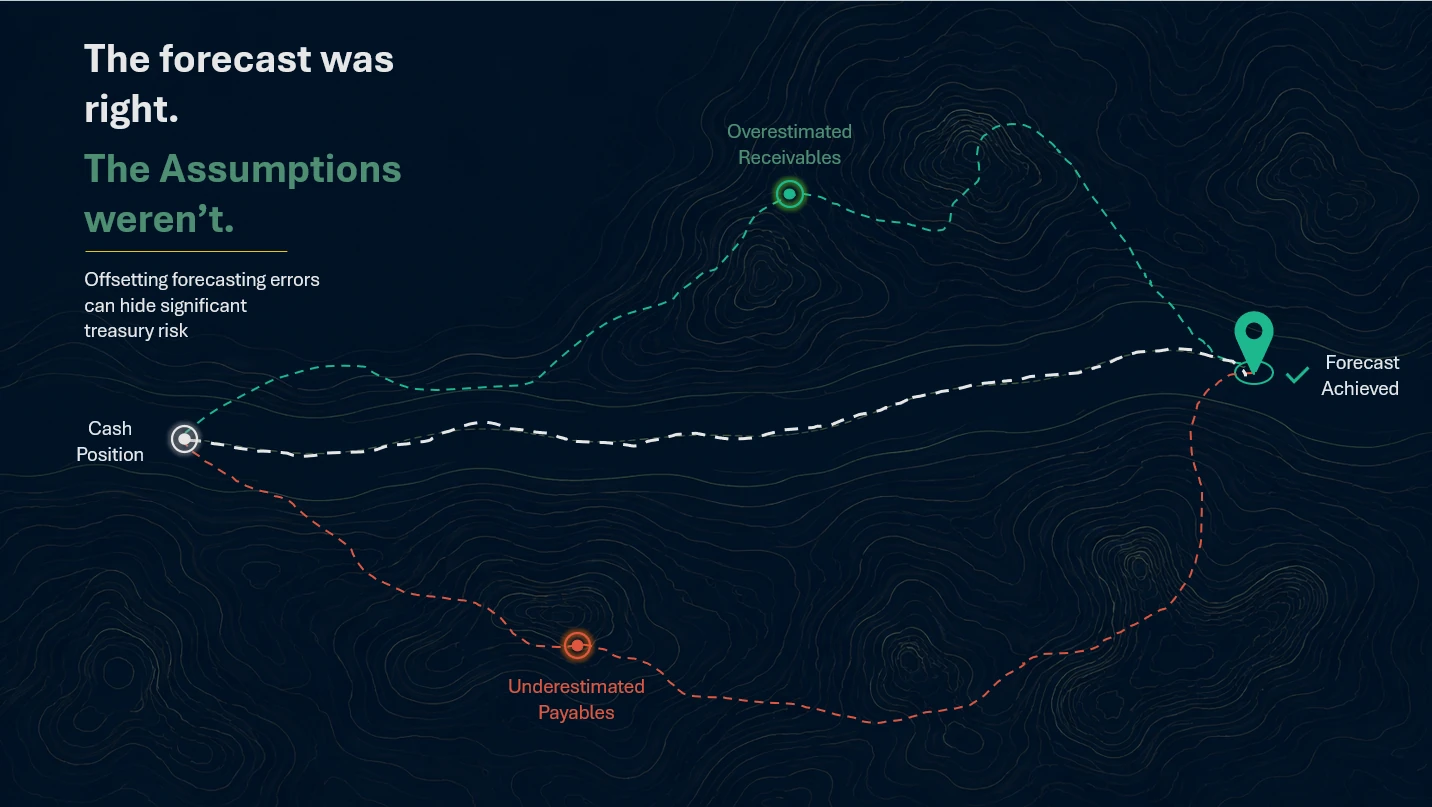
Measure the miss, line by line
Whole-forecast accuracy is a vanity number: over-collections offset under-payments and the total looks fine while both lines are wrong. Measure variance where it happens: receipts against forecast receipts, by week and by customer where it matters; payments the same. Two numbers per line tell the story: how big the misses are, and which direction they lean.
Bias and noise are different diseases
Bias is the lean. If customer receipts land a week later than forecast, month after month, that's not bad luck, it's a systematically optimistic input, and it's correctable today: shift the assumption to match observed behaviour. Noise is genuine surprise, the scatter left over once bias is removed, and you don't fix noise with better guessing. You fix it with buffer: noise is precisely the quantity your minimum cash level exists to absorb. Confuse the two and you'll either chase random scatter with endless model tweaks, or treat a fixable lean as fate.
The loop, and who sits in it
Accuracy improves through one mechanism: forecast, compare, explain, adjust, weekly. The explain step is where most companies fail, because the person who supplied the number never hears it was wrong. Close that loop and the inputs improve on their own; sales stops promising day-30 receipts from a customer who has paid on day 45 for a year. The cheapest forecasting reform available: when a line misses, the person who owns the line explains it at the weekly review. No blame needed. Visibility does the work.
When statistics help, and when they don't
Statistical and machine-learning methods are genuinely useful where behaviour is high-volume and habitual: thousands of customer receipts have patterns that a model finds faster than an analyst.
LLMs make errors, but so do humans, and with the pace of model improvements, those error rates will soon fall below human capability (if they haven't already).
The biggest danger they bring is complacency. They won't see the misses that hurt: the biggest customer changing payment behaviour, the contract that slips a quarter. The kind of change you only get from talking to people on the front line. Automate the routine lines, but spend the time you save gathering information from stakeholders, otherwise you will spend more time interrogating the lumpy misses (and probably cursing your AI).
The same job at three sizes
Start-up. Accuracy tracking is one column in the runway sheet: expected vs actual, weekly. … read more show less
Root out founder optimism: pipeline receipts booked before they're contractual. Strip those into a separate tier and the forecast's honesty increases immediately.
Established mid-market. Variance by line, weekly review, named owners per input, and bias corrections logged so the same fix isn't rediscovered quarterly. … read more show less
This is where forecast accuracy becomes a KPI with a trend, reported alongside the forecast itself.
Large corporate. Statistical models/LLMs on the high-volume lines, exception review on the rest, and subsidiary scorecards. … read more show less
In a group, forecast bias is organisational: the subsidiary that always forecasts conservatively is managing its own headroom at group's expense.