The yield on 10-year US Treasuries reached its highest level in 20 years last week. UK 30-year gilt yields hit 6%. I've read a number of pieces warning of the dangers of higher rates, including references to the collapse of Silicon Valley Bank (SVB), which we wrote about previously when examining counterparty risk (SVB, Credit Suisse & Argentex: Counterparty Lessons).
US rates may have reached a higher level than during the SVB episode, but we don't expect to see the same stress this time around for a couple of reasons.
The main reason is that banks and regulators are pretty good at shutting the stable door after the horse has bolted, so new regulations usually do a pretty good job of avoiding a replay of the previous crisis, but not of protecting from new/different risks.
Why it's different this time
The move in US rates is not as severe. While the absolute level of rates might be higher, the magnitude of the move has not been as intense. In the case of SVB, much of their investments were built up at historic low rates in 2020/2021. They subsequently saw rates rise over 3% over the following 3 years. In contrast, the current recent high in 10-year yields of 5.29% is 50 bps higher than the January 2025 high, and around 30 bps above the 2023 high.
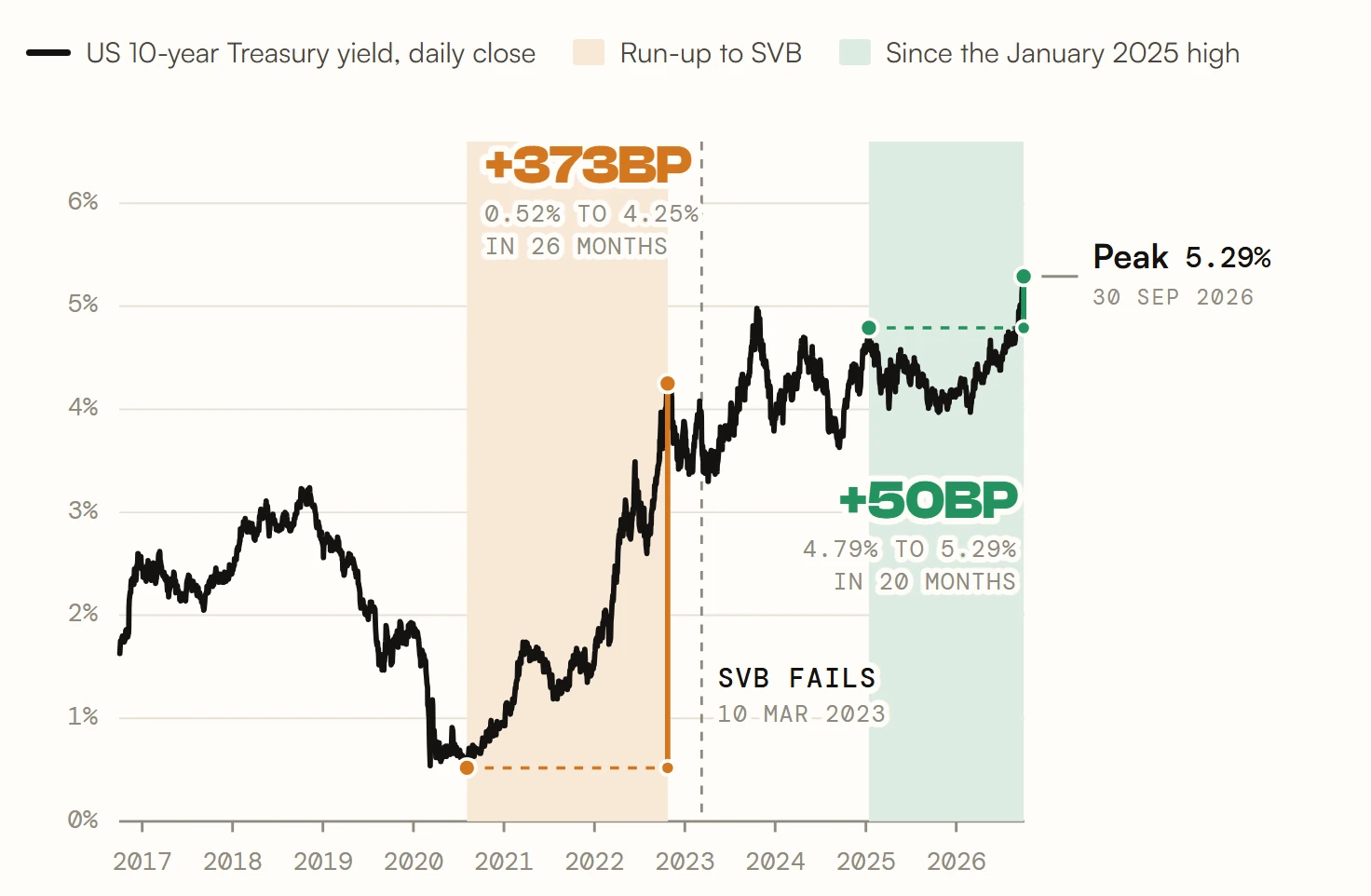
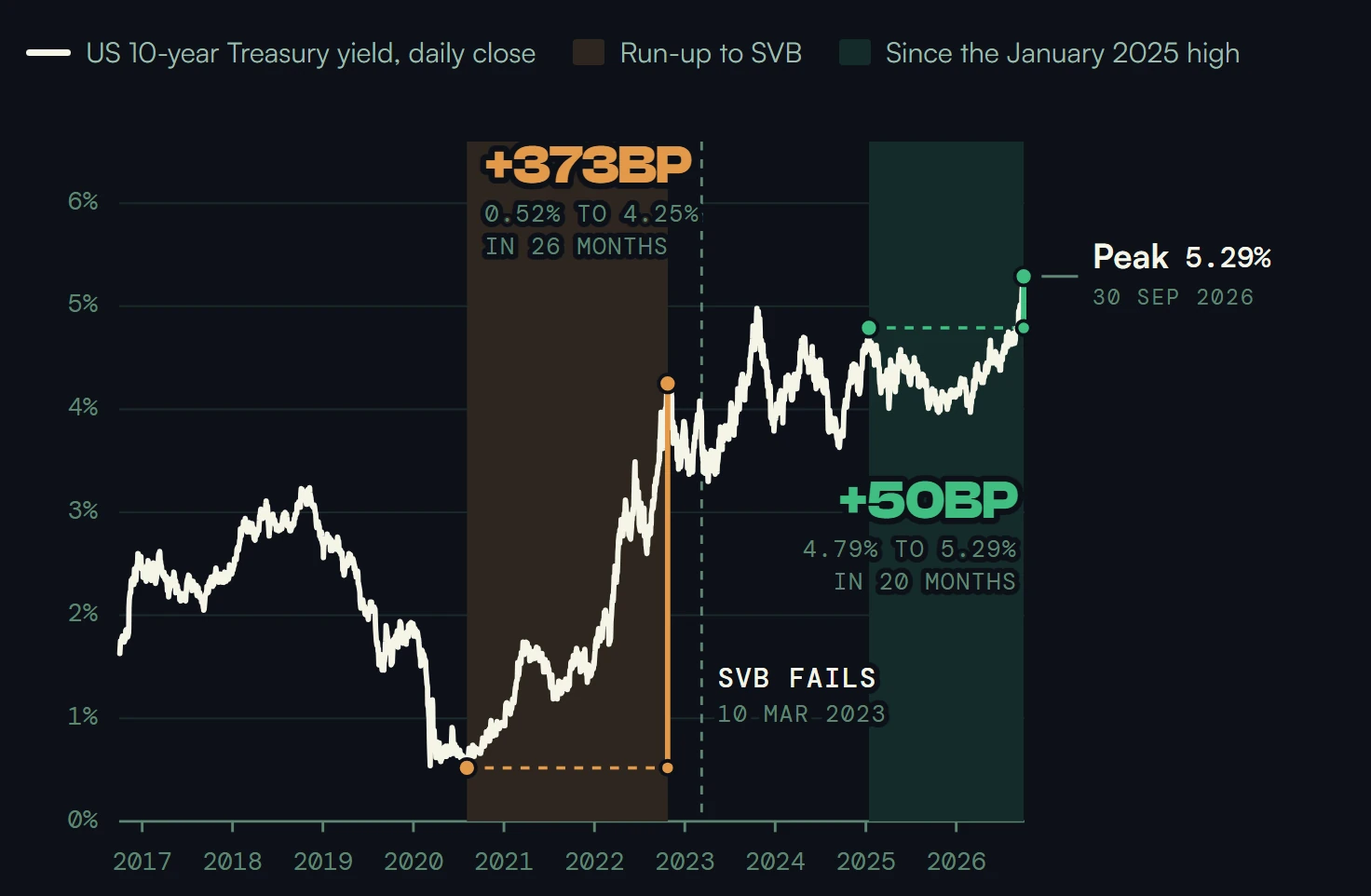
US 10-year Treasury yield, daily close. Source: Federal Reserve Bank of St. Louis (FRED).
Banks are not as exposed. Per the Federal Reserve's Financial Stability Report, May 2026: "Banks have continued to reduce exposure to a potential rise in interest rates by shortening duration as their balance sheets moved toward less interest rate sensitive short-duration securities." Banks have also already swallowed some of the losses as low yielding investments entered into in 2020/2021 have matured.
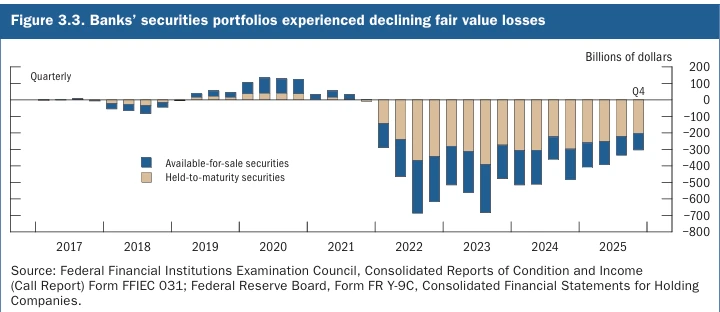
Source: Federal Reserve, Financial Stability Report, May 2026.
Banks are holding more capital against their assets. Once again, from the most recent Fed Financial Stability Report, May 2026. Apart from the largest Global Systemically Important Banks, mid and large sized banks are holding more capital against their assets than they did 3-4 years ago.
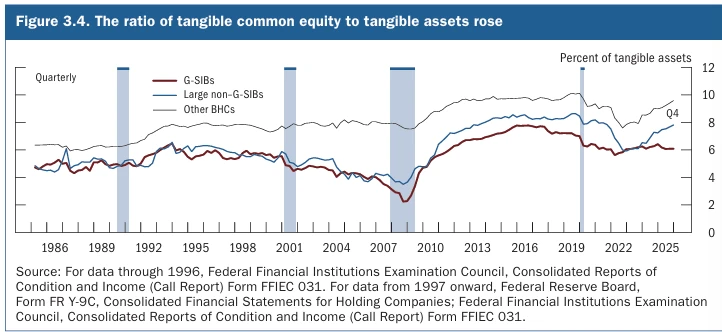
Source: Federal Reserve, Financial Stability Report, May 2026.
Banks have recognised the ability of technology to exacerbate a run. Silicon Valley Bank experienced $40bn of outflows in a single day as well informed, tech savvy depositors acted quickly on rumours about their liquidity. Most banking apps now have limits on maximum daily withdrawals and individual payment sizes, with larger withdrawals controlled by an approval process.
So how could the recent run up in rates affect corporate treasurers?
Refinancing costs. Rates are higher across the UK, US and Eurozone due to a mix of geopolitical tensions, higher energy prices, and expectations about central bank policy. … read more show less
Higher rates mean higher refinancing costs. Anyone with US and UK debt maturing in the next 12 months will be doing so in a less than benign environment, as both rates and credit appetite move against them.
FX spot and forward rates. This depends on which currency you buy or sell. … read more show less
In theory, higher rates generally attract investment from lower yielding currencies, strengthening the currency with the higher interest rate. There are numerous factors that affect spot FX movements, but the 4% strengthening of the USD against the Euro in recent months has at least partially been driven by a reversal of expectations that incoming Fed chair Kevin Warsh would cut rates. With the EURUSD spot rate reaching its lowest level in 15 months, the recent move in spot rates favours anyone selling USD and buying Euro.
Forward rates on the other hand tend to be driven more directly by interest rate differences, ignoring other factors. Rates in the US have risen by more than rates in Europe over the last 6 months, so the interest rate differential has widened. This means the adjustment on top of the spot rate for buying USD with Euro at a future date has increased, partially offsetting the unfavourable move in the spot rate. For USD sellers on the other hand, this acts as a headwind, increasing the cost of locking in the favourable spot move for future cash flows settling further into the future.
Interest rate hedging, valuations and break costs. As rates rise (particularly when the rise is experienced across the curve), the fixed rate you can lock in on a loan, either directly via a fixed rate loan or via a swap, will be higher. … read more show less
This can make the hedging decision particularly precarious for treasurers at higher rates. Do you lock in now, at a rate above the prevailing rate, which itself is the highest level in a number of years, or remain unhedged and hope that rates return to more accommodating levels? It's not an appealing decision, and the natural reaction is often to do nothing. A better response is to have a dedicated policy in place which gives the treasurer guidance through the decision, and removes the emotion and the blame.
On the other hand, higher rates improve the value of existing fixed rate loans and hedges. In both cases, the decision to fix is doing exactly as intended, protecting from a move higher in rates. This is reflected in lower or potentially no break costs if you decide to repay or (for some reason) refinance a fixed rate loan early. It is also reflected in a positive mark to market valuation on your fixed rate swap or cap.
Real estate investments. Real estate investments (and other similar investments with long term projected cash flows) are particularly vulnerable to higher interest rates. … read more show less
There are a number of reasons, including higher refinancing rates and higher expected capitalisation rates, requiring more attractive (lower) acquisition pricing from investors.
A number of German property funds have been liquidating assets (including Irish investments recently) to meet redemption demands, and are considering emergency gating measures to preserve liquidity and protect investors (Deutsche Bank's asset manager explores curbs on German property funds).
M&A. Whether the acquirer or the target, higher interest rates generally lead to lower valuations. … read more show less
The combination of higher discount rates for future cash flows, higher funding costs and higher required rates of return lead to lower valuations and lower prices paid or received in M&A transactions.
Is there anything you can do now?
As with most risk management, it's better to plan for these things in advance than try to address them reactively.
Whether FX or rates hedging, or refinancing, a considered, approved policy helps avoid difficult decisions and frustrations when rates move unfavourably.
Before rushing into a decision, consider the alternatives.
Reforecast.
- Do your original forecasts hold up in the new, higher rate environment? If not, revise and update.
- How are your cash flows affected by the higher interest payments, and better/worse FX rates?
- How does this impact profitability, EBITDA, headroom on your covenants etc.?
Scenario analysis and hedging. What is your sensitivity to another +/-100-200bp move in rates, or 5-10% in FX? Can the company handle it? If not, you may need to hedge at least some exposure at these levels; if you can stomach it, maybe you can take more risk to ride it out. If neither is appealing, maybe you have to pay some premium to get optionality (IR caps or FX options), to give you protection, but letting you benefit if the rate environment improves.
Refinancing. If you have an upcoming refinancing requirement in the next 12 months, don't wait, start assessing your requirements and alternatives.
- Assess your financing need. If you have excess cash, it may not have made sense to pay down low cost debt previously, but it may be time to revisit that decision now.
- Shop around. Don't assume the existing source of finance is the best or cheapest source.
- If possible, can you refinance all or part of the debt in advance? This may lock in rates at relatively high levels, but it removes the risk of refinancing at even higher levels in the future.
- If you can't refinance, you can at least hedge the interest rate risk in advance, using either a forward starting interest rate swap, or a swaption (an option to enter a swap at a future date).