Treasury management is a broad discipline, and some of it gets genuinely complex — option structuring, hedge accounting, notional pooling. But strip it all back and the job is one sentence: make sure the business has enough money, in the right place, in the right currency, at the right time.
That sounds simple. It rarely is. Cash arrives late, or in the wrong currency. Interest rates move against your debt. A bank you've relied on for years suddenly looks shaky. A big contract lands and doubles your FX exposure overnight. Treasury is the discipline of seeing these things coming — and having an answer ready before they arrive.
Treasury is not accounting (and it's not FP&A either)
The three get bundled together, especially in smaller finance teams where one person wears all the hats. The difference is the question each answers. Accounting tells you what happened — accurate, auditable, backward-looking. FP&A tells you what the plan says should happen to the P&L. Treasury deals in the cash and the risk in between: what could happen, and whether you'll still be able to pay people when it does.
A business can be profitable on paper and still run out of cash. Every insolvency practitioner has a story about one.
Four pillars
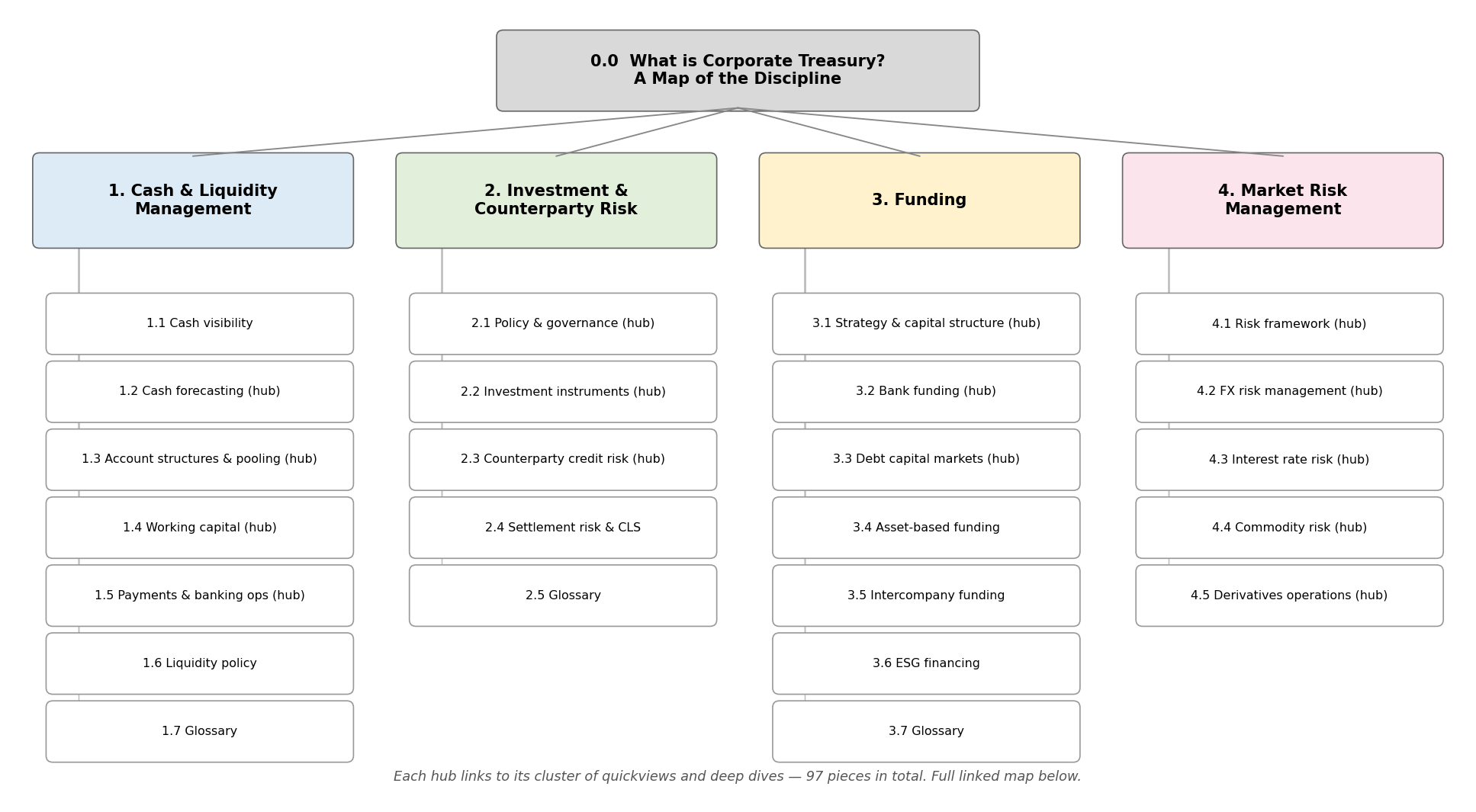
We've organised this series around the four core areas of corporate treasury:
- Cash & liquidity management. Knowing how much cash you have, where it is, and what's coming — visibility, forecasting, account structures, working capital and liquidity buffers. This is the foundation; almost everything else in treasury comes back to it.
- Investment & counterparty risk. What to do with the cash you don't need today, and who you can trust to hold it. The corporate order of priorities is security, liquidity, yield — in that order, and the order matters more than the yield.
- Funding. Where money comes from when you don't have enough: bank facilities, debt markets, asset-based finance and everything in between — plus the covenants and fine print that come attached.
- Market risk management. What FX rates, interest rates and commodity prices do to your margins, your covenants and your cash flows — and the policies, strategies and products you can use to manage it.
The same job at three very different sizes
One thing this series will keep coming back to: treasury looks completely different depending on the scale of the company. The principles carry across; the priorities, tools and failure modes don't.
| Start-up / scale-up | Established mid-market | Large corporate | |
|---|---|---|---|
| Who owns it | The founder or FC, alongside everything else | The CFO or FC — often a first dedicated treasury hire | A treasury department, sometimes regional centres |
| The tools | Spreadsheets and online banking | Spreadsheets under strain; first TMS conversations | TMS, in-house bank, direct market access |
| The priorities | Runway. How many months of cash, and when to raise | Forecast discipline, first policies, bank relationships, first hedges | Optimisation: pooling, layered hedging programmes, market funding |
| Typical blind spot | FX and rate risk ignored entirely | Policies exist on paper but aren't trusted or used; risk measured in notionals | Complexity itself — structures nobody fully understands any more |
Most of our writing speaks to the middle column; established mid-market companies managing real exposures without a dedicated treasury function. But each theme's pillar article shows all three, because knowing what you can safely skip and what you need to prepare for is a valuable insight.
How to use this series
Every theme follows the same structure. A pillar article introduces the theme. Hubs introduce sub-topics — cash forecasting, FX hedging products, bank funding. Quickviews are short reads that explain one concept properly. Deep dives go long, with worked examples and case studies. And each theme ends in a plain-English glossary.
Everything is tiered by difficulty. Foundation assumes no treasury background at all. Intermediate assumes the foundations. Advanced is where we get into option Greeks, delta hedging, TARFs, VaR and ISDA terms.
If you're a CFO or finance leader short on time: read the four pillars and skim the glossaries — you'll know where every conversation with your bank is heading. If you're building a treasury career: work through each theme in order, Foundation to Advanced. The map below is the index either way.
The map: every article in the series
The series spans over 100 articles and we will continue to add more as you request them or we feel we can add value. Each entry becomes a live link as it's published, so this page doubles as the series index. Bookmark it if you plan to come back.
Theme 1 — Cash & Liquidity Management
1.0 Cash & Liquidity Management: The Foundation of Treasury — Intro Article
1.1 Cash Visibility: You Can't Manage What You Can't See — Quickview
1.2 Cash Forecasting: Building a Forecast You Can Trust — Intro Article
1.2.1 Direct vs Indirect Forecasting Methods — Quickview
1.2.2 Choosing Forecast Horizons: Daily, 13-Week, Rolling 12-Month — Quickview
1.2.3 Measuring & Improving Forecast Accuracy — Deep Dive
1.2.4 Scenario Planning & Stress-Testing the Cash Forecast — Deep Dive
1.3 Bank Account Structures & Cash Concentration — Intro Article
1.3.1 Physical vs Notional Pooling — Quickview
1.3.2 In-House Banks, POBO & ROBO — Deep Dive
1.3.3 Trapped Cash & Restricted Markets — Quickview
1.4 Working Capital: Treasury's Role — Intro Article
1.4.1 The Cash Conversion Cycle Explained — Quickview
1.4.2 Improving DSO & DPO Without Damaging Relationships — Quickview
1.4.3 Supply Chain Finance & Dynamic Discounting — Deep Dive
1.5 Payments & Banking Operations — Intro Article
1.5.1 Payment Rails Explained: SWIFT, SEPA, Faster Payments & RTGS — Quickview
1.5.2 Bank Relationship Management & Wallet Allocation — Quickview
1.5.3 Treasury Technology: From Spreadsheets to TMS — Deep Dive
1.5.4 Payment Fraud: Common Attacks & Controls — Quickview
1.6 Setting a Liquidity Policy: Minimum Cash & Headroom — Deep Dive
1.7 Key Terms: Cash & Liquidity Glossary — Glossary
Theme 2 — Investment & Counterparty Risk
2.0 Investing Corporate Cash: Security, Liquidity, Yield — In That Order — Intro Article
2.1 Investment Policy & Governance — Intro Article
2.1.1 Writing an Investment Policy That Works — Deep Dive
2.1.2 Cash Segmentation: Operating, Reserve & Strategic — Quickview
2.2 Short-Term Investment Instruments — Intro Article
2.2.1 Bank Deposits: Call, Notice & Term — Quickview
2.2.2 Money Market Funds: CNAV, LVNAV & VNAV — Deep Dive
2.2.3 T-Bills, CP, CDs & Repo: The Direct Menu — Quickview
2.2.4 Bank Repo for Corporates — Quickview
2.3 Counterparty Risk — Intro Article
2.3.1 Credit Ratings Explained — Quickview
2.3.2 Beyond Ratings: CDS Spreads & Market Signals — Deep Dive
2.3.3 Setting Counterparty Limits & Diversification — Deep Dive
2.3.4 Lessons from Counterparty Failures: SVB, Credit Suisse & Argentex — Deep Dive
2.3.5 Deposit Protection: What's Actually Covered — Quickview
2.4 Settlement Risk & CLS — Quickview
2.5 Key Terms: Investment & Counterparty Glossary — Glossary
Theme 3 — Funding
3.0 Corporate Funding: How Companies Finance Themselves — Intro Article
3.1 Funding Strategy & Capital Structure — Intro Article
3.1.1 Debt vs Equity & the Cost of Capital — Quickview
3.1.2 Diversifying Funding Sources & the Maturity Ladder — Deep Dive
3.1.3 Refinancing Risk & Liquidity Headroom — Quickview
3.2 Bank Funding — Intro Article
3.2.1 RCFs & Term Loans: The Workhorses — Quickview
3.2.2 Loan Documentation: Covenants, Reps & Events of Default — Deep Dive
3.2.3 Reference Rates After LIBOR: SONIA, SOFR & EURIBOR — Quickview
3.3 Debt Capital Markets — Intro Article
3.3.1 Bonds & Private Placements — Deep Dive
3.3.2 Commercial Paper Programmes — Quickview
3.3.3 Issuer Credit Ratings: Getting & Keeping One — Quickview
3.4 Asset-Based Funding: Invoice Finance, ABL & Leasing — Quickview
3.5 Intercompany Funding: Structures, Pricing & Pitfalls — Deep Dive
3.6 Sustainability-Linked Loans & Green Bonds — Quickview
3.7 Key Terms: Funding Glossary — Glossary
Theme 4 — Market Risk Management
4.0 Market Risk: Managing FX, Interest Rate & Commodity Exposure — Intro Article
4.1 The Risk Management Framework — Intro Article
4.1.1 Identifying & Quantifying Exposures — Deep Dive
4.1.2 Writing a Hedging Policy: Risk Appetite, Ratios & Instruments — Deep Dive
4.1.3 Measuring Market Risk: Sensitivity, VaR & Cash Flow at Risk — Deep Dive
4.1.4 Hedge Accounting Under IFRS 9 — Deep Dive
4.2 FX Risk Management — Intro Article
4.2.1 Three Types of FX Exposure: Transaction, Translation & Economic — Quickview
4.2.2 Setting Budget FX Rates — Deep Dive
4.2.3 FX Hedging Strategy: Ratios, Horizons & Layered Hedging — Deep Dive
4.2.3a FX Hedging Strategy II: Advanced Strategies — Deep Dive
4.2.3b FX Hedging Strategy III: The Pitfalls of No Strategy — Deep Dive
4.2.4 FX Hedging Products: Choosing the Right Tool — Intro Article
4.2.4a FX Forwards & NDFs — Quickview
4.2.4b FX Swaps: Rolling & Managing Hedges — Quickview
4.2.4c Vanilla FX Options: Paying for Flexibility — Quickview
4.2.4d Option Structures: Collars, Participating Forwards, Seagulls & Beyond — Deep Dive
4.2.4e Exotic Structures: TARFs, Accumulators & When to Walk Away — Deep Dive
4.2.5 Pricing FX Trades: Spot, Forward Points & How Your Bank Makes Money — Deep Dive
4.2.5a Forward Markets & the Cost of Hedging — Deep Dive
4.2.6 Option Pricing, the Greeks & Delta Hedging — Deep Dive
4.2.7 Executing FX: Dealing, TCA & Multi-Dealer Platforms — Quickview
4.2.8 Managing Translation & Balance Sheet FX Risk — Deep Dive
4.2.9 Key Terms: FX Glossary — Glossary
4.3 Interest Rate Risk Management — Intro Article
4.3.1 Fixed vs Floating: Framing the Exposure — Quickview
4.3.2 IR Hedging Products: Swaps, Caps, Collars & Swaptions — Deep Dive
4.3.3 The Yield Curve & How Swaps Are Priced — Deep Dive
4.3.4 Pre-Hedging Future Debt Issuance — Quickview
4.3.5 Hedging Term, Certainty & Break Costs — Deep Dive
4.3.6 Deal-Contingent Hedging — Quickview
4.4 Commodity Risk Management — Intro Article
4.4.1 Identifying Commodity Exposure & Proxy Hedging — Quickview
4.4.2 Commodity Hedging Instruments: Futures, Swaps & Options — Deep Dive
4.4.3 Basis Risk: When the Hedge Doesn't Match — Quickview
4.5 Derivatives Operations & Documentation — Intro Article
4.5.1 ISDAs, CSAs & Credit Terms for Corporates — Deep Dive
4.5.2 Regulatory Reporting: EMIR & Derivatives Compliance — Quickview
4.5.3 Confirmations, Settlements & Valuations: The Back Office — Quickview
4.5.4 Zero/Zero Credit Facilities: No IM, No MTA — Quickview
What's coming first
We'll publish in a deliberate order: this opener, then the four pillar articles, then each theme's hubs before their articles. Foundation pieces before Intermediate, Intermediate before Advanced. Several pieces already exist in draft and will land early.
If there's a topic on the map you need sooner, or a topic you’d like to add, please let us know.