At Hedj, we've been building a peer analysis tool to help companies gain insights into industry trends, best practice and peer comparison, to assist in their decision-making process.
One industry we use continuously to benchmark our results is the aviation industry. Its combination of large, highly scrutinised companies with a history of failures and restructuring, sharing significant exposure to a particularly volatile commodity (jet fuel), during the current period of exceptional price uncertainty, makes for a deep source of insights for treasury managers. We could write case studies for months documenting the approaches, successes and failures of individual airlines when it comes to managing their treasury exposures, but we have tried to condense the key points below.
Introduction
In late February 2026 the Strait of Hormuz closed. Brent went from the low $70s to over $120 a barrel within a month. The move in jet fuel was even more extreme. By the end of March, jet fuel had risen from below $100 to $187 for US jet deliveries. European airlines had it worse. Jet delivered into north-west Europe, the CIF NWE price most of them buy against, reached $1,698 a tonne on 16 March, about $215 a barrel (Platts, as reported by S&P Global).
The move highlighted the different approaches to fuel hedging adopted by airlines, and different approaches on either side of the Atlantic.
We examine four approaches.
- Ryanair had hedged most of its exposure months in advance.
- United Airlines' policy is to remain unhedged.
- Wizz Air and Lufthansa used options to put a ceiling on the price, giving up some or all of the benefit if prices fell.
- Delta Air Lines. Like United, they don't employ derivatives to hedge, but they own an asset, in the form of a fuel refinery, which gives some offset to increased volatility, and in particular higher spreads between the price of oil and jet fuel.
None of them is right or wrong. Each is the result of a considered decision by an experienced management team, guided by their own experience, financial situation and the idiosyncrasies of their business model.
1. Ryanair: hedge it
Ryanair's approach is the textbook one.
- It hedges jet fuel itself, not crude (this might seem obvious, but many airlines hedge using crude oil or other proxies for jet for a number of reasons, which we explore in more detail in the article on basis risk and proxies).
- It hedges on a rolling basis, typically around 80% of the coming financial year, and adds to the year after when prices dip.
- It hedges a significant portion of the FX exposure associated with its USD denominated fuel exposure.
This rigorous approach has served Ryanair well as fuel prices have remained elevated.
Lessons from experience
They haven't always been as diligent in their hedging, but have learned their lessons well. In 2008, they reported being 90% hedged at $65/bbl when Brent rose above $80/bbl. However, they gambled that prices would fall, reducing their hedge ratio heading into the summer of 2008 to just 10%, leaving them badly exposed when fuel prices remained elevated and even rose further.
Since then, they have maintained a high hedge ratio for medium term exposures more consistently.
Implications of a consistent, high hedge ratio
Michael O'Leary himself said of the savings of more than €1.4bn generated from the hedging programme in 2023 that he would "ascribe that more to dumb luck than supremely intelligent management".
Sometimes you make your own luck, but there is value in judging a hedging programme over a longer time frame, not just its highs and lows, and Ryanair have experienced some ugly lows.
- In 2016 they were hedged at well over market rates, forcing them to watch unhedged competitors cut fares and gain a competitive advantage.
- In 2020/21 when international travel shuttered completely, they took charges of over €600mn to cut out of derivatives that were hedging fuel purchases that were no longer necessary. That in itself was an admirable act of financial discipline which many companies stumble at, as the temptation to push out unprofitable hedges to a future date despite uncertainty is a trap many fall into.
- The discipline paid off in 2023 as the company estimated savings of €1.4bn from hedging at $64/bbl as Brent approached $100/bbl, and again in 2026/27 as fuel prices have spiked again to unprecedented highs.
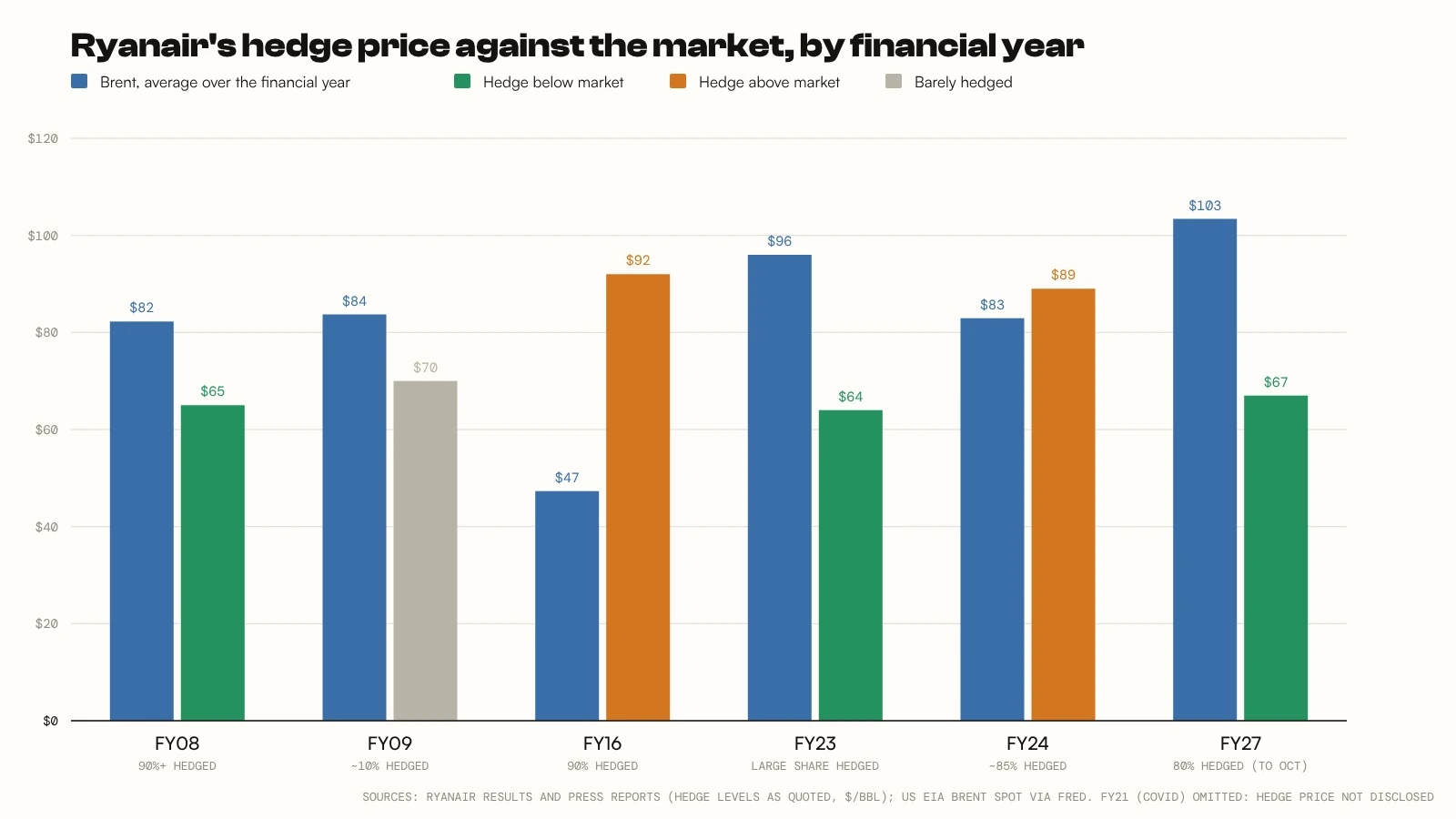
The approach highlights a few things. The main one is the management attitude which is necessary to support the hedging programme. No victory laps when the hedges are significantly in the money, but also the discipline to continue hedging even when the existing hedges are a drag on profitability.
2. United Airlines: risk it
United's 10-K is admirably blunt: its "current strategy is to not enter into financial transactions to hedge the market price exposure" of its fuel. Its fuel supply contracts are tied to market prices and, in United's words, "customarily do not provide material protection."
Their logic is simple. Fuel is an industry-wide cost. If every big US carrier is unhedged, fares move together, and the customer pays. Hedging is a bet on oil that US airline boards have lost often enough that many have given up on it.
What replaces the hedge is commercial muscle. United raised fares hard and cut flights that lost money even if that meant slightly emptier planes.
This approach isn't perfect. Seat repricing significantly lags fuel price moves, often coming after most of the period's tickets had already been sold. In Q3 2026, United recaptured 72% of a $1.8bn quarter-on-quarter fuel increase through pricing adjustments, but that still leaves around half a billion dollars that went straight to earnings (source: Q3 2026 earnings call).
Their strategy also has an upside the hedgers don't get. When fuel falls, United keeps every cent of it from day one, while hedged competitors stay locked in.
3. Options: buying insurance
Everything else sits between Ryanair and United. Many airlines pay hefty premiums to try to achieve the best of both worlds, i.e. purchasing options. In their simplest form, the airline pays a premium for a cap on their fuel price, but there are a number of other variations to cover different risks or reduce the cost of the strategy.
Bought calls and caps: pay up front, keep the downside
A bought call, or cap, is insurance. You pay a premium. If fuel rises above the strike, the option pays the difference. If it falls, you let it expire and buy cheap fuel at the market rate (as if you hadn't hedged). The cost is the premium, and you pay it whether or not you ever claim.
Southwest is usually filed here, but its 10-K describes a mixture: purchased calls, collars, call spreads, put spreads and fixed-price swaps, on Brent in recent years. By its own account its hedging saved around $3.5bn against the industry-average fuel price between 1998 and mid-2008, when it was about 70% hedged at $51 a barrel while rivals paid $130. Then oil fell, and Southwest lost more than $1bn on hedges over 18 months in 2015 and 2016. The 10-K draws the line itself: collars and swaps can leave it owing money at settlement, while bought calls and call spreads can't.
Options don't remove hedging cost completely. In the first quarter of 2025 hedging still added 7 cents a gallon (about $3 a barrel), $37m, to Southwest's fuel bill, while the airline was trying hard to cut costs.
In Q2 2025 it stopped adding positions, citing "higher premium costs over time," and closed its hedging book.
Alaska Airlines also ran a programme of crude call options until it stopped buying them in 2023.
Unfortunately, both decisions landed just before sizeable spikes in fuel prices.
That's the problem with bought options. The cost shows up every year and the payout shows up rarely, so boards tire of paying for protection just before they need it. In such a volatile market, that premium fatigue is exacerbated by higher premiums and wider spreads.
Collars: no premium, but not free
Wizz Air is the clearest current example. Most of its book is zero-cost collars, with jet fuel swaps for shorter-dated exposure. A collar pairs a bought call (the cap) with a sold put (the floor). The premium earned from selling the floor pays for the cap, so no money changes hands at the start. "Zero cost" describes that opening premium, not the outcome.
For the nine months to March 2027 Wizz has 73% of its fuel covered, with a cap of $826 a tonne (about $105 a barrel) and a floor of $759 (about $96). Here's how that works on each hedged tonne, before into-plane costs, basis differences and settlement timing:
- Market at $1,200 a tonne (~$152/bbl): Wizz buys fuel at $1,200 and the cap pays it $374. Net cost $826 (~$105/bbl).
- Market at $800 (~$101/bbl): between the strikes, nothing settles. Net cost $800.
- Market at $600 (~$76/bbl): Wizz buys at $600 but owes $159 on the floor it sold. Net cost $759 (~$96/bbl).
So the collar turns any market price into an effective price between $759 and $826 a tonne, roughly $96 to $105 a barrel, on the hedged share only. The unhedged quarter still pays the market rate.
Wizz pays lower premiums, or none, but unlike the standalone cap, if prices collapse, Wizz remains exposed to a hedged fuel price, albeit at the floor rate, which is slightly lower than the fixed rate they might have locked in had they hedged using simple fixed contracts.
Spread hedges: cover the gap, not the price
Lufthansa adds a little more complexity. It hedges up to 24 months ahead, mainly with what it calls spread options on crude oil and gas oil, and can add forward hedges on the price difference between kerosene and crude, or gas oil and crude. Those forwards are a different kind of hedge. They don't protect the price of fuel. They protect the gap between jet and crude, the crack spread, which is the part of the 2026 move that crude-only hedges missed. A company can lock that gap and still be fully exposed to crude, or the other way round.
For a mid-market treasurer, bought options have one practical advantage that's easy to miss. A bought cap needs no credit line, because once you've paid the premium the bank has no exposure to you. A collar doesn't give the same advantage, because of the floor you've sold. It's the same logic as the interest-rate caps in 3.5.3, and a bought cap is often the quickest hedge a smaller company can get approved.
4. Delta: refine it yourself
Like United, Delta stopped hedging after losing $2.3bn on hedges in 2015 and paying about $450m to get out of out-of-the-money hedge trades in 2016. CEO Ed Bastian's verdict: "I've lost way too much money hedging fuel. So I swore off that drug a long time ago."
But they are not entirely unhedged. What they have instead is the Trainer refinery outside Philadelphia, bought through its subsidiary Monroe Energy in 2012. They paid north of $150m to buy it and invested a further $100mn to improve its capacity to refine jet fuel, but according to Delta it could take $300m a year off its fuel bill.
Owning a refinery doesn't give them free fuel, or insulate them from the volatility in fuel prices.
Refineries still buy unprocessed crude oil, so they are exposed to the underlying price volatility in the barrel of oil.
What the refinery protects them from is the fluctuation of the crack spread, the difference between the price of a barrel of oil and the equivalent of jet fuel that barrel produces.
If crude doubles and the crack spread stays put, Delta's fuel bill doubles like everyone else's.
In 2026, however, a significant portion of the move in jet fuel prices has been a result of a rising crack spread. Between the third quarters of 2025 and 2026, US Gulf Coast jet rose about $72 a barrel on EIA spot prices. The rise in Brent accounted for $27 of that. The other $45, about 62%, was the crack spread, which is the slice a refinery earns.
The refinery offers "a meaningful hedge" but it doesn't remove the price risk or the basis risk entirely.
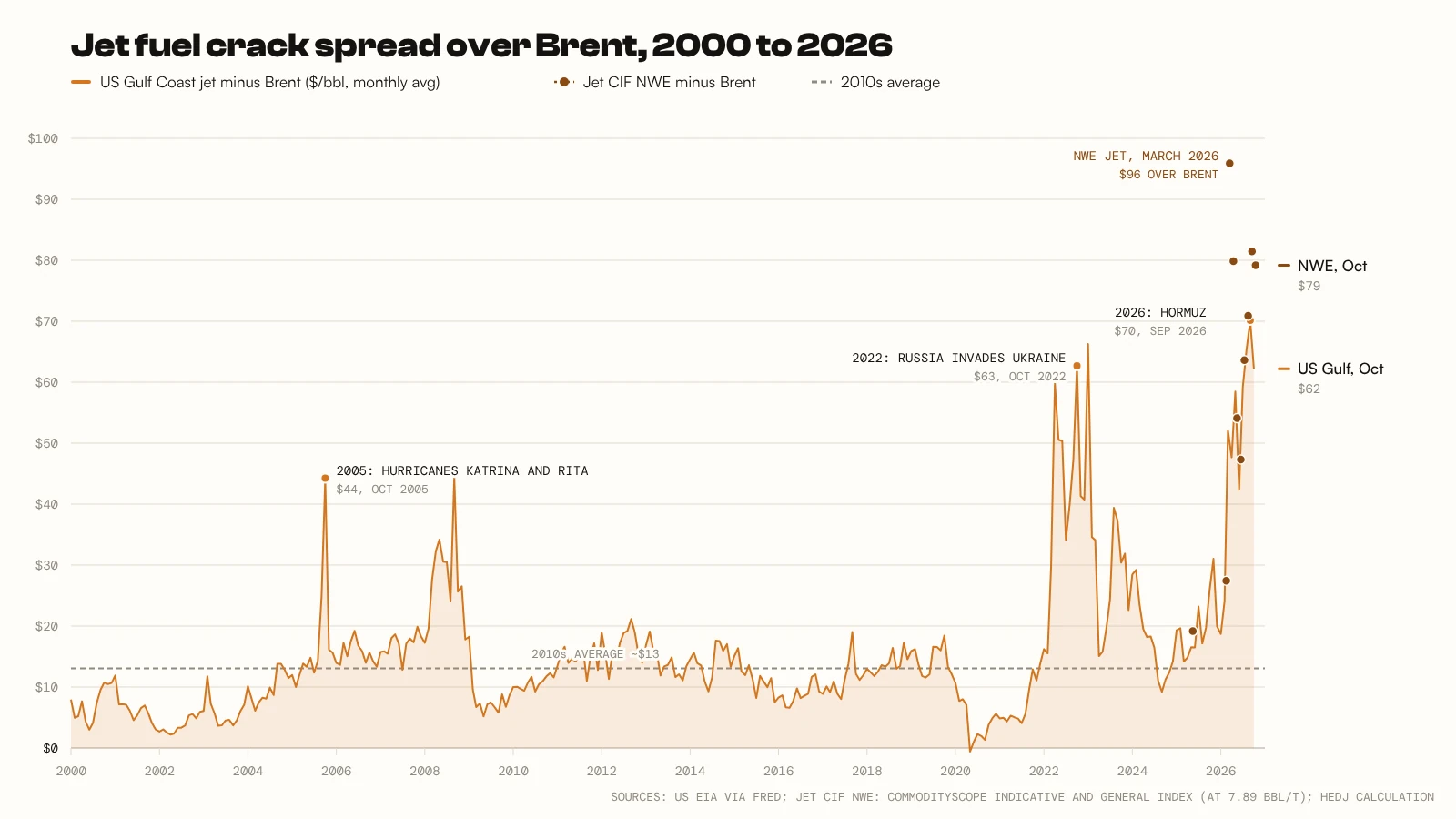
Method: monthly averages of US EIA daily spot prices via FRED, US Gulf Coast jet (dollars a gallon times 42) minus Brent, in US dollars a barrel, January 2000 to October 2026. NW Europe points are CommodityScope indicative monthly averages (General Index for May 2025), converted at 7.89 barrels a tonne, minus the same EIA Brent average. The 2010s average is the mean of the 2010 to 2019 monthly values.
Delta transfers the refinery's jet to the airline at market prices, using the New York Harbor index, so this isn't free, or even cheap fuel. It's a separate business whose margin tends to widen when jet gets expensive relative to crude. Tends is the right word. Outages, the product mix, crude costs and compliance bills all move on their own, so while they hedge the basis risk between Brent and jet, they add a whole new level of basis risk of their own.
What it cost
This partial hedge is not free, or even particularly cheap. The original purchase, $150m net of state support plus $100m of conversion work, was the start. Delta's 10-Ks show $1.62bn of refinery capital spending from 2012 to 2025. Renewable Fuel Standard compliance cost $312m in 2025 and $203m in 2024. And for its first decade the refinery barely washed its face: reported segment operating income from 2012 to 2021 adds up to $108m, with losses in five of those ten years.
Then the crack blew out. Segment operating income was $777m in 2022 and $1.36bn across 2022 to 2025. Since 2012 the refinery has earned about $1.47bn of operating income against $1.62bn of capital spending, and 2026 should narrow or close that gap.
When viewed like that, the refinery has acted very similarly to an option hedging programme, requiring ongoing working capital and investment instead of premiums, and only "paying out" when crack spreads have blown out and margins have jumped (which happens to have coincided with the price of Brent and jet rising sharply).
The hedging strategy comes with its own set of risks, not least the operational risk of owning physical assets. A fire at Trainer on 25 June knocked part of the plant out and cost Delta 5 cents a gallon (about $2 a barrel) in the second quarter, right when the refinery's value was at its peak. And the "no paper hedging" isn't quite true for the group as a whole, as the refinery trades derivatives around its own inventory.
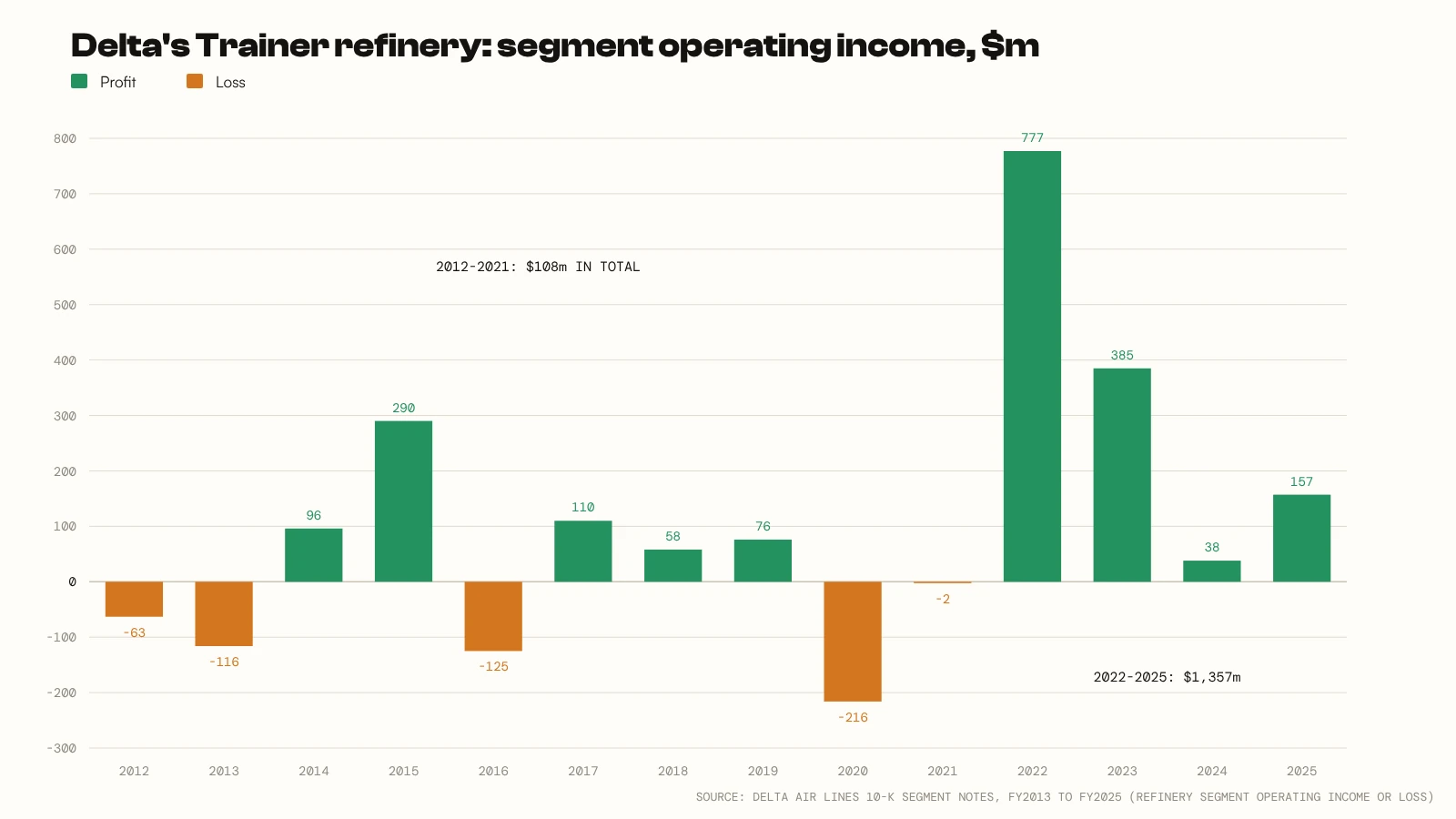
Method: refinery segment operating income (loss) as reported in the segment notes of Delta's annual 10-K filings, US dollars, calendar years 2012 to 2025. Segment results are after depreciation and before interest and tax, and include sales to the airline valued at New York Harbor market prices. They are not an investment return.
Comparing the approaches
| Hedge (Ryanair) | No hedge (United) | Cap (Wizz, Lufthansa) | Refine (Delta) | |
|---|---|---|---|---|
| Budget certainty | High for the year ahead | Low | A ceiling, not a fixed price | Low to medium |
| Covers a crude spike | Yes | No | Yes, above the cap | No |
| Covers a crack spike | Yes, if you hedge jet | No | Only if the option or spread hedge is on jet | Partly |
| Benefit when prices fall | No | Yes, immediately | Yes with bought options; only down to the floor with a collar | Yes on crude, but refinery margins may shrink |
| Main failure mode | Prices fall or volumes collapse | Fuel rises faster than fares | Premiums paid for years with no payout, then cancelled before the spike | Operational risk. Outages and thin cracks, with capital tied up for years |
| What you need | A strong balance sheet and a consistent board that holds its nerve | Pricing power, and competitors who also float | A budget for premiums and a board that values the insurance | Deep pockets and an appetite to run a refinery |
Business models: what lets United and Delta float while Ryanair hedges?
Not hedging only works if you can afford the lag between fuel going up and fares catching up.
United and Delta can, mostly because a large slice of their income has nothing to do with the price of a seat.
Delta's partnership with American Express paid it $8.2bn in 2025. On its own it's bigger than Delta's entire $6bn fuel cost increase this year.
Premium cabins, airmiles & loyalty programmes, cargo and maintenance work for other airlines now make up 60% of Delta's revenue.
United is on the same path: premium revenue up 11% and loyalty up 9% in 2025, with $15.2bn of liquidity to ride out a bad quarter.
Premium passengers also complain less about fares. A business-class customer flying on the company's card notices a fuel-driven fare rise less than a family going to Faro.
Ryanair's model is the mirror image. It sells cheap seats to price-sensitive leisure travellers and wins on the lowest fare, so it can't raise prices overnight.
Regional differences: why Europe tends to hedge and the US tends not to
The split also looks geographic. Every big US airline has sworn off hedging, while most of the big European carriers hedge two-thirds or more of the year ahead. Location isn't the cause on its own, but there are distinctions that drive behaviour on both sides of the Atlantic:
- Two exposures, not one. A European airline buys fuel in dollars and earns in euros or sterling, so a fuel spike that arrives with a strong dollar hits twice. European airlines have to worry about currency and fuel (and carbon). A US airline only has the fuel price to worry about.
- Fares that move together. Four airlines carry most US domestic traffic (United, American, Delta and Southwest) and none of them hedge, so none of them lose a competitive advantage when fuel prices rise. Even Southwest, whose low cost model Ryanair mirrors, has moved away from fuel hedging as its option based strategy was deemed too expensive.
- Card deals the EU caps. Delta's $8.2bn from American Express rests on US card interchange fees. The EU has capped consumer credit card interchange at 0.3% since 2015, so European airlines can't build anything like the same buffer from ancillary services.
- A cheaper forward dollar. When a European airline hedges forward, it buys both the fuel and the dollars to pay for it. The oil curve may or may not slope downwards: over the last 20 years, forward fuel prices have been below spot roughly 60% of the time. But buying dollars forward with euros has been cheaper than buying them spot for a much larger share of that period, because US interest rates have mostly sat above euro rates. So European buyers are more likely to lock in a discount on their fuel by buying forward than their US counterparts.
None of this makes floating right for a European airline, or hedging wrong for an American one. Some European airlines, such as SAS and airBaltic, carried little or no cover going into 2026, but the rationale is different to the US airlines.
Hedging: a luxury some can't afford
Hedging isn't only a choice. It's often a luxury afforded by a strong balance sheet and ample cash balances. Airline fuel hedging programmes require derivative lines on a scale that can make their bank credit teams wince.
A stronger counterparty can access larger, unsecured lines, or a high threshold before any collateral is due. Many smaller operators are required to place initial margin and variation margin with exchanges or their banks to support their hedging trades, or move down the chain to mid-market financial counterparties where margins might be wider. The other alternative is paying a premium to buy an option, which doesn't create a credit exposure for the financial counterparty, but this is a running expense that many airlines have given up on, and smaller airlines often can't afford.
Ryanair is rated BBB+ by S&P and Fitch, and Lufthansa BBB- (Baa3 at Moody's). Neither publishes its hedging terms, but investment-grade airlines are the credits banks are most willing to trade with unsecured or on generous thresholds. Even then, a big enough fall still costs cash. In 2009 Southwest, also investment grade, had $425m of cash posted with its hedge banks and had pledged 49 Boeing 737s instead of more.
At the other end is Latvian carrier airBaltic. It ended 2025 with €28m of cash against a €25m minimum-liquidity covenant, and Fitch cut its rating to CCC- in April 2026. It went into the Hormuz spike only about 10% hedged, while Ryanair, easyJet and Wizz sat at 60% to 80%.
airBaltic hasn't said why, but an airline with €3m of liquidity headroom has nothing to post as collateral and little to spend on option premiums. And it paid the price, filing for bankruptcy protection in September, with discussions of a restructure ongoing.
Before it collapsed, Spirit Airlines, in the US, was even blunter: its filings said it lacked the creditworthiness or liquidity to post collateral, and as a result, couldn't hedge its fuel exposure. It stopped flying on 2 May 2026.
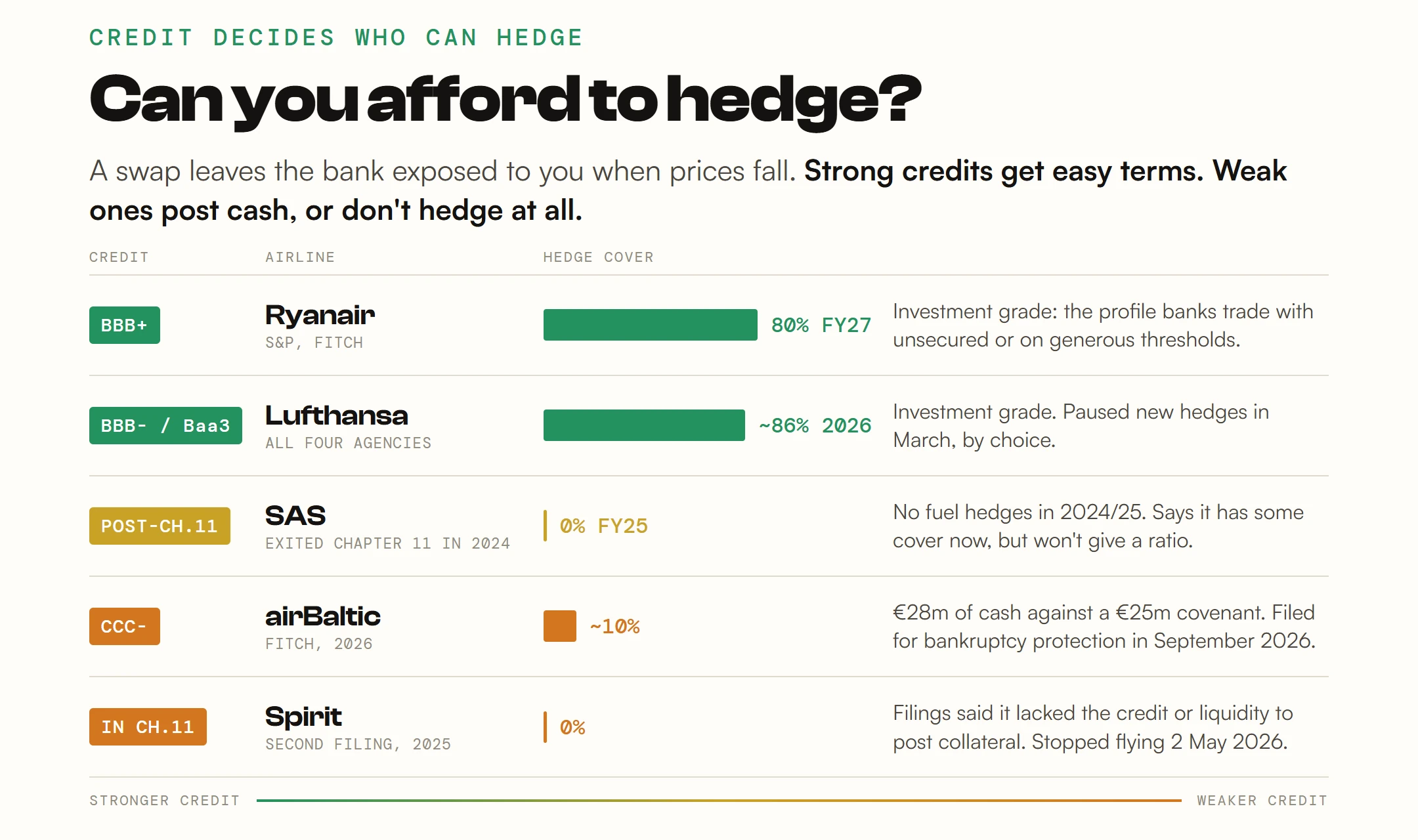
The research backs the pattern. Across 23 US airlines, hedging fell from about 30% of next year's fuel to under 5% as carriers slid into distress (Rampini, Sufi and Viswanathan, 2014). The airlines that most need protection are the ones least able to buy it.
Once bitten, twice shy
One interesting point of note. For the airlines with the most dedicated approach to either hedging or not hedging (Ryanair, United, Delta, Southwest), their approach to hedging has almost universally been informed by past trauma.
For Ryanair, that trauma was a failed bet on falling prices in 2008/2009 leading to a lower hedge ratio as prices rose. The outcome, a consistently applied high hedge ratio ever since.
For United, Delta and others, the trauma was the opposite. Repeated experiences of large hedging losses while prices remained low or fell led them to swear off hedging en masse.
For Southwest and Alaska it was the persistent leaking of premiums, which (in Alaska's case at least) didn't lead to particularly strong hedging outcomes anyway due to the basis risk in their crude oil hedging strategy.
Put the four side by side and the common thread isn't hedging against floating, or options against swaps. It's fit. A strategy works when it matches the exposure you actually have, jet rather than Brent and the volumes you'll really burn. It has to match how much loss the balance sheet can take before you're forced to act. And it has to match how long you need to reprice or cut costs. Ryanair hedges because it can't raise fares quickly. United floats because it can, and because card income covers the lag. Delta's refinery fits a balance sheet big enough to run one. Wizz's collars fit an airline that wants a ceiling but won't pay a premium. Most of the failures in this piece result from a strategy that stopped fitting the business, or a rash decision to adjust the strategy.
Lessons for corporate treasurers
- There is no "right answer". Airline treasuries are some of the largest, most experienced and most capable in the world, and they still haven't reached a consensus on how to manage their fuel risk. Don't judge yourself too harshly if you have the same questions.
- Policy beats prediction. A hedge ratio set in advance protects you from the temptation to predict the market.
- Judge a programme over the full cycle. Ryanair's 2026 gain and its 2016 and 2021 costs are the results of the same policy. This requires broad buy-in from stakeholders and understanding (in advance) of the potential drawbacks as well as benefits of a particular policy.
- Understand what you're hedging. Ideally your hedge matches your exposure exactly, or as closely as possible. If not, make sure you (and your stakeholders) understand the differences and the implications.
- Hedging buys time, not a permanently lower price. Use the time to build up hedges or adjust the business model.
- Don't make rash decisions. Many of the largest airline hedging losses have come from aggressive decisions to deviate from policy following a sharp move in markets, or a period where existing hedges settled out of the money.
- Maintain strong relationships with your financial counterparties. The ability to get large facilities is what enables the larger airlines to hedge the way they do. Some of that will be driven by your balance sheet, but a good relationship and trust go a long way, as does the bargaining power of having more than one counterparty. Your job as treasurer is to manage the balance between both.
- Know your competitors. Understanding how your competitors manage their risk can have as big an impact on your strategic hedging decisions as internal considerations. Knowing when they will be forced to reprice is as important as knowing your own constraints.